by Mark | Oct 2, 2023 | Education, Employment Issues
In recent years, a significant transformation has been underway in the world of employment. The traditional belief that a college degree is an essential prerequisite for many jobs is being challenged like never before. In 2023, we are witnessing a remarkable trend where fewer companies are requiring college degrees when making hiring decisions. This shift is driven by various factors, including a changing job market, evolving workforce demographics, and a growing emphasis on skills and competencies. At Web Professionals Global, we see firsthand how non-degree programs like our certifications help professionals develop their skills and grow in their careers. Let’s dive into some of the factors that have led to this shift:
The Changing Face of the Job Market
One of the key drivers behind the decline in the insistence on college degrees is the evolving job market. As technology continues to reshape industries and create new roles, the demand for specific skills and competencies often takes precedence over formal education. Many of the fastest-growing job sectors for web professionals, such as technology, data science, and digital marketing, value practical skills and hands-on experience over traditional degrees.
The Rise of Skills-Based Hiring
Companies are increasingly recognizing that skills-based hiring can yield more suitable candidates for specific roles. Instead of relying solely on academic qualifications, employers are focusing on assessing candidates’ abilities and competencies directly related to the job. This approach allows companies to identify candidates who possess the skills necessary to excel in their roles from day one.
The Impact of Skills Shortages
Skills shortages in various industries have compelled companies to reconsider their hiring criteria. Many sectors in which web professionals work have seen demand for qualified workers exceed the available supply. To bridge these gaps, employers are becoming more open to candidates with relevant skills, certifications, or vocational training, even if they lack a traditional degree.
Remote Work and Globalization
The rise of remote work and globalization has made it easier for companies to tap into talent pools worldwide. This shift has forced organizations to reevaluate the importance of degrees when hiring remote workers. In a global talent market, companies are prioritizing skills, experience, and the ability to work effectively in virtual teams over traditional academic credentials.
The Changing Attitude of Millennials and Gen Z
Millennials and Gen Z workers, who now make up a significant portion of the workforce, have different perspectives on education and employment. Many of them question the value of accumulating student debt to earn a degree, especially when alternative learning paths and online certifications like those from Web Professionals Global are readily available. Companies are adapting to this generational shift by focusing on what candidates can bring to the table, regardless of their formal education.
Success Stories Without Degrees
Numerous high-profile success stories of individuals (including many Web Professionals Global members) who achieved remarkable career success without college degrees are inspiring both job seekers and employers. These stories highlight that talent, dedication, and a willingness to learn can often trump formal education. Companies are increasingly willing to take a chance on unconventional candidates who can demonstrate their potential and abilities.
2023 marks a pivotal year in the evolution of hiring practices. The decreasing emphasis on college degrees signals a broader recognition of the changing dynamics in the job market. Companies are looking beyond academic credentials to identify the talent, skills, and potential that candidates bring to the table. This shift not only benefits job seekers from diverse backgrounds but also allows companies to access a broader and more talented pool of candidates, ultimately driving innovation and success in an ever-changing business landscape.
Work With Us
If you are a student, young professional or experienced professional, certifications from Web Professionals Global can help you advance in your career. Take advantage of the shifting employment landscape and begin learning in-demand skills today that will help you in the global marketplace.

by Mark | Jun 15, 2023 | Employment Issues, Web Design, Web Development
In tough economic times, some industries rise while others fall. Industries that make money or help others make money seem to always fare better than others. We have heard how the tech industry has been laying off large numbers of employees and contractors. You can argue much of this is COVID-19 fallout, with companies still fearing a potential recession.
The headcount at Twitter has been reduced by 70% in the past year. Facebook laid off about 13% of employees in 2022, and will probably lay off another 12% in 2023. Other tech companies that have recently reduced workforce numbers include LinkedIn, Amazon, Apple, Netflix, Microsoft, Yahoo, Zoom, Salesforce and more.
However, these figures are just one side of the equation. Looking at the U.S. Bureau of Labor statistics for May, we can see that U.S. tech occupations across the economy increased, and the unemployment rate decreased slightly from 2.1% to 2.0%. The current national average unemployment rate across all occupations is 3.7%. This means that even with big cuts in the large tech companies, we are seeing great resilience in the tech job market as a whole. Specifically, web design and development jobs are as strong as ever.
What Do the Numbers Say?
With all the economic turmoil in the tech sector, is entering a career in web design and development a good idea? Let’s look at the numbers. Overall, employment of web developers and digital designers is projected to grow 23 percent from 2021 to 2031, which is a much faster rate than the average for all occupations. It is estimated that there will be 21,800 openings for web developers and digital designers annually over the next decade. A large portion of these openings will be to replace retiring designers and developers.
So, why is web design and other tech careers growing even in the times of layoffs? Web design and development is key to how companies make money. Every company needs to get its product story to market, which is where the web designers and developers come in. Web design is key to how a company makes money.
Think about it: who are the creative people managing the search engine optimization (SEO) that drives connections with the customers? Who creates the engaging content, graphics and sites that deliver the product story that gets people to buy? The answer is web developers and designers who help to execute marketing in a way that makes a company successful.
What Can I Do With Web Design and Development Skills?
Although many people think of the tech world when it comes to web designers and developers, they are in high demand in virtually all industries including healthcare, energy, manufacturing, telecommunications, financial services, and retail. Put simply, any company or organization that needs to reach a target audience and maintain an online presence must have designers and developers. Those with web design and development skills can work in many different areas including programming, cybersecurity, database management, AI and robotics, graphic design, information security, user experience (UX) and others.
The good news is that a career in web design and development does not require a traditional four-year degree. You can earn certifications, like the ones we offer here at Web Professionals Global, that will demonstrate your skills and set you apart when it comes to proving yourself in the professional working world. If you have a certification (or multiple certifications) and a portfolio of projects you have created, hiring managers will be eager to talk with you because they know you would be starting with them ready to hit the ground running on day one. Plus, many designers and developers work on their own with a variety of different clients and act as their own bosses.
Why is it Important to Be Part of a Community of Professionals?
If you are considering becoming a web design or development professional, take advantage of becoming part of the largest community of web professionals in Web Professionals Global. Our mission is “Community, Education and Certifications,” and we help promote the advancement of all professionals in internet-based careers. We have special programming and certifications for web educators and teachers, and we work with teachers who want help or direction from a local or regional professional as well as independent and remote designers and developers who need advice running their own business. Web Professionals Global really is the one-stop shop for those in internet-based careers at any level.
Start Your Career Today
Whether you are a teacher looking for web design and development certifications for your students, or you are an adult seeking to transition into a new career, we can help. Reach out to us today to learn how Web Professionals Global can assist you in advancing your career.

by Steve Waddell | Jan 6, 2023 | Employment Issues
LinkedIn recently published an article discussing the trend of companies in the tech world shifting toward hiring contractors instead of full-time employees. As Web Professionals Global is made up of tech professionals who work in a variety of roles and capacities, we thought it important to highlight this trend. Why is this happening?
First, let’s look at some of the pros and cons of being a contractor as opposed to a full-time employee.
What are the pros?
- Freedom to choose clients and customers
- Ability to work from wherever
- Ability to set own hours
- Flexibility to drop difficult clients
What are some of the cons?
- Less job security
- Fewer (or no) benefits like 401(k), healthcare options, etc.
- Fewer colleagues can mean less camaraderie and more isolation
- Limited career development opportunities
Put simply, more companies are turning to contractors because they can be hired at a lower cost than full-time employees. For example, a full time employee must be paid a salary and benefits. Those benefits can amount to 50% or more additional expenses beyond base salary. In this tough economic environment, tech companies have engaged in mass layoffs. However, work still needs to be done. Companies use contractors to continue operations without the added cost of retirement benefits, healthcare benefits, and more. Additionally, many contractors work remotely, which saves companies on overhead costs like office space and utilities.
Companies also have more flexibility when they hire contractors. A contractor-heavy workforce allows companies to rapidly scale up and down as business needs and goals shift throughout the year. The tech world is constantly changing, and companies in Silicon Valley and beyond are likely to continue relying heavily on contract employees. If you work in tech, or would like to work in tech, consider if contract opportunities might be right for you. As we discussed, there are upsides and downsides to both contact work and full-time employment. Our work at Web Professionals Global prepares secondary students and adult learners to enter careers in web design, animation, mobile app development and more.
Mark DuBois, our Executive Director, talked about the role of contractors in tech: “In my three decades of experience in the world of web, I have been part of many teams that relied on contractors to get projects done. There will always be a need for contractors, and independent contracting can be a wonderful way for web professionals to work directly with clients on projects they choose. We here at Web Professionals Global are proud to support tech contractors around the country and around the globe.”
Learn More
Are you interested in becoming an independent contractor or seeking to enter the tech world? Contact us today to find out how Web Professionals Global can help you reach your career goals. Whether you are a full time employee or a contractor, don’t forget the importance of current certifications to validate your value to an organization. In addition to our many certifications in web technologies (such as web designer, web developer, mobile app developer, and web animation), we also offer remote working certifications.

by Steve Waddell | Aug 15, 2021 | Employment Issues
Virtually every industry has been affected by the COVID-19 pandemic over the past year and a half. Companies and organizations in web design and development, finance, healthcare, IT, education and many more have scrambled to adapt to the new normal that is work from home (WFH). In turn, many employees have come to the realization that they are happier and just as productive in their jobs when working from home. As some companies and organizations have begun to require that employees return to the office, workers are weighing their options and beginning to think in ways that they might not have before the pandemic.
A recent study by Upwork estimated that 10 million workers in the U.S. are considering becoming freelancers, or independent contractors, due in large part to the fact that the vast majority of freelancers work remotely. The trend has been coined “The Great Resignation,” as the majority of workers consider themselves “neutral” or “not excited” at the prospect of going to the office and have considered resigning in favor of a position that offers remote work or leaving full-time work and freelancing on their own. Among those surveyed, 20% are considering becoming freelancers. 73% of those respondents cited the ability to work remote or flexibly as a reason why they would seek to work as a freelancer.
Many workers are so invested in staying in a remote job that they would even take lower pay. The study found that 15% were willing to take a pay cut to be a remote worker, and another 26% would possibly take a pay cut. And among workers who consider themselves unhappy to be returning to the office, nearly two-thirds would consider taking a pay cut to work remotely.
Web designers and developers are in a great position to take advantage of this new dynamic and find jobs that offer remote work or even get their own clients and work as a freelancer. With the growth of remote work, the internet tools we rely on every day to work and communicate will become even more important, and designers and developers will continue to be in high demand.
The Bureau of Labor Statistics estimates the annual growth rate for web design jobs will be 15% in the coming years, more than double many other professions. In recent years the median salary for web designers has been around $70K, with the top 10% earning more than $120K. And approximately 16% of web designers are freelancers/self-employed, which is higher than most other industries. Other similar occupations such as web developers and graphic designers have a high percentage of professionals working as freelancers. There is clearly a big opportunity for those who aspire to work in these fields and envision themselves working remotely as freelancers.
The Web Professionals Organization is dedicated to supporting web professionals in all industries—including those who work remotely and in a freelance capacity. If you are interested in learning more about the professional and educational opportunities that the Web Professionals Organization offers, reach out to us today.
by Steve Waddell | Mar 10, 2021 | Employment Issues
I am what you would call a “Transitioner.” I worked in various fields including the hotel industry, sales and most recently, manufacturing.
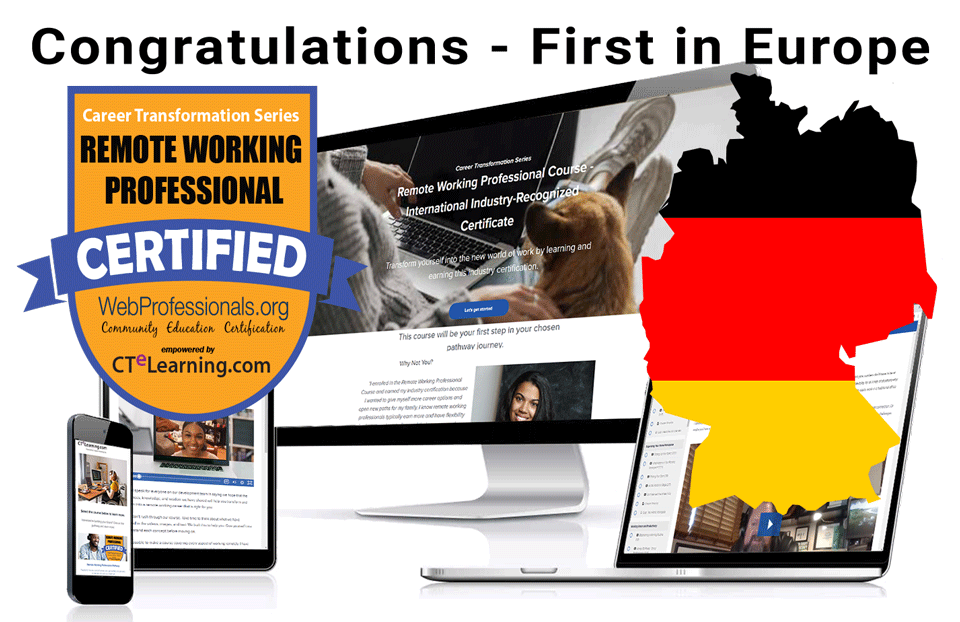
I was already taking a course to receive a full industry-recognized certification in web design when I saw the opportunity to take a course and get a certification as a Remote Working Professional. I had to read it twice. Remote Working Professional? Then it hit me—over the last couple of years, so many of the best jobs shifted to working from home. I realized now is the time to think strategically about my future. Getting these credentials and certification gives me extra credibility when applying for a flexible remote working job, which is a big attraction to me. It also gives me an edge over anyone else who is applying for the same remote position.
Part of me thought I should wait and complete the certification I was already working on. I mean, who needs more work? However, I then saw that I could finish this in just a few hours, and I could even go through the course on my smartphone. When I realized I could complete the course and certification in just a couple visits to my favorite coffee shop, it became a no-brainer.
I wanted to be ready to launch into a new remote career, since I know the world is rapidly shifting to remote work. Many of the best jobs available are remote positions.

An international professional association endorses the Remote Working Professional Certification course. I know that may not mean much to the average job-seeker, but I know from experience that potential employers do look at who certifications come from. A certificate from a business, or for just taking a class, is not the same as a certification from an international industry organization.
What I also loved about the course, which I was not expecting, was how it spoke to how to highlight my transferable skills. This was a new term to me, and essentially means that the skills that I learned in hospitality, sales and manufacturing can be applied to other positions—including remote jobs. This signals to employers that I have core skills that qualify me for the job, even if I may be new to the industry. I have read Department of Labor research that suggests that people usually change their careers 3-7 times in their lifetime.
I also surprised myself to have the guts to start as a freelancer or remote professional after completing the course. You hear these terms mentioned all the time, but nobody tells you what to do to get hired for a remote career. Yes—the course has an option for learning how to become a freelancer as well. Through the Remote Working Professional Course conducted by CTeLearning I gained much more insight in regards to starting a life as a freelancer.
Another big bonus I discovered in the course is the section dedicated entirely to preparing for an interview, in any industry, for a remote working job. The reality is that how you approach answering questions for remote work is different than for a job where you show up to an office.
The highlights of the course were learning specific answers to the following questions:
- How do you deal with conflict?
- What do you do to keep motivated?
- How do you safeguard data and manage cybersecurity?
These topics were my personal favorites as they gave me real tips and tools to set up my next career for success.
I recommend everyone invest in the Remote Working Professional course and certification. Many life lessons have been compacted in a couple of chapters, and they are easy to put into practice!
One of my favorite quotes from Jim Rohn is, “It’s important to learn from your mistakes, but it is BETTER to learn from other people’s mistakes, and it is BEST to learn from other people’s successes. IT accelerates your own success.”
I had no idea all the responsibilities that came along with working remotely, but now I am more confident to start my career in the remote world thanks to all the professionals that participated in the making of this wonderful course.
—Ingrid F. K. Soto
Visit here for more information about the Remote Working Professional Course.

by Steve Waddell | Mar 3, 2021 | Employment Issues
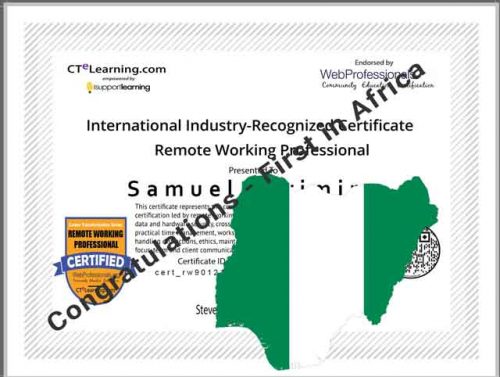
Web Professionals and CTeLearning would like to congratulate Samuel T, the first recipient of the Remote Working Professional (RWP) Certification in Africa. As a resident of Nigeria, Samuel completed the RWP course and earned his certification all on his mobile phone, which allowed him to work on the certification anytime and anywhere.
Samuel earned his certification by answering a series of questions at the end of each chapter on what a competent remote working professional should know. Samuel also completed the Interview Preparation Course, which prepares learners for interviewing for a job in the remote working world. Samuel is now an in-demand remote working professional equipped with an international industry-recognized certification (IIRC) that is recognized by companies around the globe.
Samuel discussed the impact the course will have on his professional career: “I took this course when I was working remotely for a tech company. It taught me a lot of things I didn’t consider beforehand, especially as someone new to the world of remote working. One of the awesome things I love about this course is listening to a plethora of remote working professionals and the useful tips they give based on their years of experience. I strongly recommend this course to everyone working or considering working remotely.”

Samuel is not new to certifications or seeking opportunities to grow his skills and is always looking for his next step in building his career and shaping his future to allow him to follow his passions and make his family proud. In September 2020, Samuel earned his Certified Professional Web Developer Certification from the Web Professionals Organization (webprofessionalsglobal.org). A month later Samuel was hired onto a development project with a US-based company thanks to his certification and newfound connections as a member of the Web Professionals Organization.
Joshua Frisch, Co-Author of the Remote Working Professional Course, said, “Samuel embodies the type of remote learner that we are so excited to help with this course. Samuel showed that no matter where you are located in the world, you can transform your career to thrive in the new remote working economy. Samuel completed the course lessons, earned an international industry-recognized certification that is in-demand among companies, and prepared to interview for remote working positions—all by going through the course on his smartphone from his home and school. We are excited for Nigeria and Africa to have their first recipient of the RWP certification, and we are looking forward to having students across the rest of the globe join Samuel and others who have completed the course and earned certifications.”
Mark DuBois, Executive Director of the Web Professionals Organization, said “All of us here at the Web Professionals Organization love seeing people take control of their futures. Taking charge of your education and investing in yourself is always the right choice. We appreciate that Samuel looked to our community of professionals to find the support and certification to add to his growing skills to help take his passions to the global marketplace. His story is not that uncommon—he knows that the world of work has changed and he can take his skills and build a career that spans continents. We are excited to welcome more like Samuel into the Web Professionals Organization.”
Visit here for more information about the Remote Working Professional Course.