
by Mark | Mar 19, 2026 | Industry News, Web Professional Trends
As we cross the threshold into the second quarter of 2026, the digital landscape is undergoing a transformation that is less about the tools we use and more about the intent behind them. If February was defined by the maturation of agentic workflows and the native-first CSS revolution, March is proving to be the month where cognitive interfaces and data sovereignty take center stage. For the modern web professional, the challenge is no longer just building a site that works; it is about building a site that respects the cognitive load of the user and the legal boundaries of their personal data. Let’s take a look at some of the March web trends.
From Attention Economy to Calm Technology: The Rise of Cognitive Interfaces
For over a decade, the web has been an attention economy, where success was measured by time-on-page, click-through rates, and stickiness. In March 2026, we are seeing a massive industry pivot toward calm technology—interfaces designed to deliver information without overwhelming the user’s limited cognitive capacity.
This shift is driven by cognitive load theory, which suggests that the more mental effort required to navigate a site, the less likely a user is to convert, learn, or return. Web professionals are now being asked to build anticipatory interfaces. These systems use local, privacy-preserving AI to predict what a user needs next, hiding secondary options until they are contextually relevant.
We are seeing a return to true minimalism, but with a high-tech twist. Designers are moving away from infinite scrolls and pop-up overlays in favor of structured, bite-sized knowledge cards that can be consumed by both humans and AI agents effortlessly. The goal in 2026 is no longer to keep the user on the site as long as possible; it is to help the user complete their task with the least amount of friction. The professionals leading this charge are those who understand psychology as deeply as they understand JavaScript.
The Era of Personal Data Sovereignty: Decentralized Identity (DID)
Perhaps the most significant legislative and technical shift this month involves the identity layer of the web. For years, we have relied on social logins from major tech giants, which required users to trade their privacy for convenience. In March 2026, we have reached a tipping point for decentralized identity.
New regulations in the EU and emerging standards in the U.S. are pushing web professionals to implement self-sovereign identity protocols. Instead of storing user data on a central server, which creates a massive security liability and a target for hackers, sites are now acting as verifiers for digital wallets. When a user logs in, they share only the specific claim needed—such as proof of age or a valid certification—without ever revealing their name, email, or birthdate to the site owner.
This is a massive win for security. If a website is breached in 2026, there is no user database for hackers to steal because the site never owned the data in the first place. For the web developer, this means moving away from traditional SQL-based user management and toward blockchain-agnostic identity protocols. This shift is not just technical; it is a moral imperative to return the keys of the internet to the individual user.
Sustainability Mandates: The Clean Code Audit
Sustainability is no longer a nice-to-have feature of a 2026 project; it is a measurable technical requirement. This month, several major cloud providers have introduced carbon-based billing, where the cost of hosting is directly tied to the CPU cycles and data transfer weight of the application. High-energy code is now more expensive code.
This has led to the rise of the clean code audit. Web professionals are now using advanced profiling tools to identify zombie code—unused libraries, legacy polyfills, and redundant tracking scripts that consume energy every time a page is loaded. By eliminating these digital ghosts, developers can significantly lower the operational costs for their clients while participating in global climate goals.
We are seeing a resurgence of static site generation and islands architecture. By pre-rendering as much as possible and only activating interactive elements when needed, developers are reducing the thermal footprint of their sites. In 2026, the greenest website is the one that sends the fewest bytes over the wire. This focus on lean web principles is also improving accessibility, as these lightweight sites load instantly on the older hardware and low-bandwidth connections found in many rural and emerging markets.
The 2026 Accessibility Readiness Cliff and the Human-in-the-Loop
As we noted in February, the 2026 ADA deadlines for public entities are here. However, March has brought a new focus: cognitive accessibility. While we have historically focused on screen readers and keyboard navigation, the industry is now preparing for the silver standards of WCAG 3.0, which place a heavy emphasis on making the web usable for people with ADHD, dyslexia, and age-related cognitive decline.
The consensus this month is clear: AI accessibility overlays have failed the legal and functional tests. Courts are consistently ruling that an automated fix does not satisfy the requirement for an equitable experience. This has created a massive demand for human-in-the-loop testing.
We are seeing a surge in members seeking certification in accessibility auditing. These professionals don’t just run a scanner; they facilitate user testing sessions with people with disabilities to ensure that a technically compliant site is actually usable. In 2026, accessibility is the ultimate proof of professional craft. A site that excludes twenty percent of the population is no longer considered a professional product.
WebAssembly (Wasm) and the Rise of “Edge-Native” Applications
Technically, the big story of March 2026 is the widespread adoption of the component model for WebAssembly. This allows developers to build edge-native applications where code is written in any language—such as Rust, Go, or Python—and executed instantly at the edge of the network, closest to the user.
This hardware-neutral approach is the final nail in the coffin for the app store monopoly. Why build a native iOS or Android app when a WebAssembly-powered web app offers the same performance, zero installation, and universal compatibility? We are seeing professional tools—from 3D modeling software to real-time audio processors—running flawlessly in the browser on budget-friendly Chromebooks.
This is the ultimate equalizer. By removing the hardware wall, we are ensuring that a student in a rural district has the same professional-grade tools as a developer in Silicon Valley. It allows for a level of educational equity that was previously impossible to achieve.
The Death of Vaporware and the Return of the JTA
Finally, this month has seen a return to the Job Task Analysis (JTA) as the primary way we define professional success. In the early 2020s, the term web pro was often vague. In 2026, the definitions have become incredibly specific. We are seeing a move away from full-stack generalists toward verified specialists who can prove their competence in specific domains like web security, mobile app architecture, and data privacy.
Our focus on Industry-Recognized Credentials (IRC) with our curriculum partner CTeLearning has never been more relevant. Employers are tired of vaporware resumes—candidates who claim to know everything but have no verified proof of their skills. By grounding our certifications in the actual tasks a professional performs on a daily basis, we are helping both employers and employees navigate the 2026 job market with confidence.
Conclusion
We want to hear from you. How are you navigating the shift toward decentralized identity? Are your clients asking for “Carbon-Aware” designs? What challenges are you facing as the 2026 accessibility deadlines approach?
If you are ready to lead in this new era, we are here to support you with world-class education, community advocacy, and the industry-recognized certifications you need to thrive. Contact us today at hello@webprofessionalsglobal.org to join the conversation and learn more about Web Professionals Global.
Check out our February 2026 Desktop View here.

by Mark | Feb 16, 2026 | Industry News, Web Professional Trends
As we move through the first quarter of 2026, the digital landscape has entered a phase of profound consolidation. If 2024 was the year of AI experimentation and 2025 was the year of infrastructure building, 2026 is proving to be the year of professional accountability. The “move fast and break things” era has been replaced by a “build for sustainability and equity” mandate. This month’s Desktop View explores the convergence of AI agentic workflows, the legislative deadlines for accessibility, and the long-awaited arrival of “Native-First” development. For the modern web professional, the job description is no longer just about pixels and code; it is about managing the complex intersection of human experience and machine-readable data. Let’s take a look at some of the February web trends.
The Shift from Generative to Agentic Web Design
The most significant shift we have tracked in February 2026 is the transition from “Generative AI” to “Agentic AI.” For the last two years, we focused on how AI could help us write code or generate images. Today, the focus is on how “AI Agents” browse the web on behalf of human users. We are seeing a fundamental change in traffic patterns where a significant percentage of “visitors” to a website are no longer humans staring at a screen, but autonomous agents looking for structured data to complete a task. This has led to a renaissance in semantic HTML and schema markup. Professionals who neglected their <main>, <article>, and <nav> tags in favor of generic <div> soup are finding their sites invisible to these new agents.
Designers are now tasked with building “Dual-Interface” systems. A site must be visually stunning for the human eye, but technically transparent for the machine “eye.” This month, the industry has seen a massive surge in the adoption of JSON-LD (JavaScript Object Notation for Linked Data). By providing a clear, machine-readable map of a site’s products, services, and logic, web professionals are ensuring their clients remain relevant in an agent-driven economy. We are moving toward a “Headless-First” mindset where the data layer is just as polished as the presentation layer.
The CSS 4 Revolution and the “Native-First” Workflow
In the technical trenches, February 2026 marks the official tipping point for CSS 4. For over a decade, preprocessors like Sass and Less were mandatory tools for any professional workflow. However, with the near-universal browser support for native CSS nesting, custom functions, and advanced color-mix properties, the need for complex build steps is evaporating. This month, we have seen several major enterprise frameworks announce “Zero-Build” initiatives, moving back to lean, native CSS files.
This shift isn’t just about technical preference; it’s about performance and sustainability. By removing the compilation step, developers are reducing the “carbon cost” of their build pipelines. Furthermore, native CSS scoping (the @scope at-rule) has finally solved the “Global Namespace” problem that plagued large-scale projects for twenty years. This allows teams to build component-based architectures without the overhead of massive JavaScript libraries. For the entry-level web professional, this means the Job Task Analysis (JTA) is shifting back to a deep mastery of the browser’s native capabilities. The “specialists” of 2026 are those who can achieve high-performance results with the fewest possible dependencies.
Digital Stewardship and the Green Web Standard
Sustainability has moved from the “CSR” (Corporate Social Responsibility) report to the technical specification document. With new international regulations regarding the energy consumption of data centers and digital products, “The Green Web” is now a legal and financial imperative. This month, we observed a 30% increase in the use of “Carbon-Aware” API calls—systems that delay heavy data processing or background updates until the local power grid is running on renewable energy.
The role of web professionals has expanded to include “Digital Stewardship.” This involves optimizing images not just for speed, but for the energy cost of the transfer. We are seeing a return to “Dithered” aesthetics and “SVG-First” design languages that prioritize low data weight. This is particularly critical as we look toward the “Next Billion Users” in emerging markets, where high-bandwidth connections and high-end hardware remain luxuries. Digital stewardship is the professional recognition that a bloated website is an inequitable website.
The 2026 ADA Deadline: Accountability for All
The regulatory environment for web accessibility has reached a boiling point. As we navigate the final countdown for Title II of the Americans with Disabilities Act (ADA), small government entities and non-profits are facing a 2026 “readiness cliff.” The grace periods of the early 2020s have expired. This month has seen a record number of legal filings against sites that rely solely on “AI Accessibility Overlays.”
Web Professionals Global continues to advocate for a “Human-in-the-Loop” accessibility strategy. The industry consensus in early 2026 is clear: automated tools are excellent for catching low-hanging fruit, but they cannot replace the nuanced testing required for complex interactive components. We are seeing a massive demand for certified Accessibility Auditors who can navigate the complexities of WCAG 2.2 and the upcoming 3.0 drafts. For our members, this represents a significant high-wage, high-demand career path. Accessibility is no longer a feature; it is a foundational human right, and the web professionals who lead with this mindset are the ones securing the most prestigious contracts in 2026.
WebAssembly (Wasm) and the Death of the “Browser Limitation”
Technically, we have spent much of February discussing the maturation of WASI (WebAssembly System Interface) p2. For years, we thought of WebAssembly as a way to run high-performance games in the browser. In 2026, Wasm is being used to run secure, sandboxed code across the entire stack. This has effectively killed the “it only runs on Windows/Mac” argument. We are seeing a new class of browser-native professional tools—from video editors to CAD software—that perform at near-native speeds on any device, including Chromebooks.
This hardware neutrality is the primary driver of equity in 2026 education and industry. If the professional toolset runs in the browser via Wasm, the socioeconomic status of the user (and the price of their laptop) no longer dictates their ability to compete in the workforce. This month, several major creative suites announced they were moving their primary development focus to Wasm-based web versions, signaling the end of the desktop software era as we knew it.
Conclusion
We would love to hear your thoughts on how these web trends are impacting your own work and local communities. What challenges are you seeing, and where do you find the most inspiration lately? If you are interested in learning more about our ongoing mission to support community-led growth, provide world-class education, and offer industry-recognized certifications that open doors for the next generation, please don’t hesitate to contact us today.
Click here for our Outlook of the Web in 2026.

by Mark | Dec 18, 2025 | Industry News
If you’ve been watching your Google Search Console reports with growing concern, seeing impressions climb while clicks steadily decline, you’re experiencing the defining challenge of modern web work: the zero-click era. This isn’t a temporary glitch—it’s a fundamental transformation in how people search and how web professionals must approach visibility in 2025.
The numbers tell a stark story. According to a report from Datos and SparkToro, only 40.3% of U.S. Google searches resulted in clicks to organic results in March 2025, down from 44.2% the prior year. Meanwhile, 27.2% of searches ended without a click compared to 24.4% in March 2024. For web professionals—whether you’re a freelance designer, agency SEO specialist, in-house developer, or small business owner—this shift demands a complete rethinking of strategy.
However, our belief is that the death of clicks isn’t the death of SEO—it’s the evolution of digital strategy. The most successful web professionals in 2025 aren’t fighting against zero-click search. Instead, they are redesigning their approach around visibility, authority, and influence rather than traffic volume alone. Let’s take a closer look at what this all means for our profession.
Understanding the Zero-Click Reality
A zero-click search occurs when users find answers directly on the search engine results page without clicking through to any website. These answers appear through featured snippets, knowledge panels, AI Overviews, instant answer boxes, and other rich results.
A recent survey from Bain finds that about 80% of consumers now rely on zero-click results in at least 40% of their searches, reducing organic web traffic by an estimated 15% to 25%. Even among users skeptical of generative AI, about half say most queries are answered on the search page without a click.
With AI Overviews and AI Mode now live, we’ve entered a phase where Google’s search engine behaves more like a conversational assistant than a list of blue links.
The Real Impact on Web Professionals
SEO Specialists: You might hold position one, but if your content is outranked by an AI Overview, traffic takes a hit regardless. Traditional metrics no longer guarantee results.
Web Designers and Developers: Users might encounter your client’s brand early through a zero-click result but convert through other channels much later. Attribution models break down.
Small Business Owners: Your carefully crafted content gets synthesized into an AI response without attribution or traffic.
Content Creators: Your detailed guides populate zero-click results, yet you see none of the traditional traffic.
This fundamentally challenges the business model built on driving traffic to owned properties.
Why Zero-Click Doesn’t Mean Zero Opportunity
Despite challenges, web professionals who understand the new landscape are thriving. The key is recognizing that visibility equals success—SERP features have become destinations where the user journey often completes.
Consider this: ChatGPT drove 293 million estimated visits to websites in April 2025, and generative AI traffic to U.S. retail sites increased by 3300% year-over-year for Amazon Prime Day 2025. Zero-click doesn’t mean zero action—purchase intent is taking new forms.
Successful professionals have shifted from “How do I get clicks?” to “How do I become the authoritative source that gets featured, cited, and remembered?” They’re playing a longer game focused on brand building, topical authority, and strategic visibility.
Six Strategic Shifts for Web Professionals
1. Optimize for AI Crawlability and Semantic Search
Traditional keyword-focused optimization isn’t enough. Structure content for machine readability with clear headings, concise definitions, well-organized lists, and structured data markup. Make it easy for AI to extract, understand, and cite your information.
Ditch old habits like hiding content behind forms or in PDFs. That content won’t get indexed or featured in the new search landscape.
2. Redefine Success Metrics Beyond Clicks
Shift from click-focused metrics to measuring search impressions and AI reach. Track brand mentions in AI responses (even without links), impression share and SERP feature appearances, brand search volume, assisted conversions, and position in AI Overviews compared to competitors.
For agencies and freelancers, explain to clients that appearing in an AI Overview seen by 100,000 people may generate more brand value than 1,000 clicks from a traditional result.
3. Build Deep Topical Authority
Create interconnected content clusters that cover topics from every angle. Answer not just the main question but all related questions users might have. Demonstrate expertise through depth, not just breadth.
For web designers, showcase detailed case studies explaining not just what you did but why. For SEO specialists, move beyond simple how-to content to thought leadership that analyzes trends.
When Google’s AI needs to synthesize an answer about your specialty, you want your domain to be the first place it looks.
4. Diversify Content Formats and Platforms
Use video and interactive formats to boost visibility. YouTube is now the top destination for traditional search in the U.S., EU, and UK, and the second-most visited domain from AI tools.
Create video versions of written content. If you’re showcasing web design work, create video walkthroughs. If you’re sharing strategies, record tutorials.
Search is becoming multimodal. Web professionals who deliver content in multiple formats gain visibility in multiple SERP features.
5. Optimize for Featured Snippets and SERP Features
Structure content with clear, concise answers to common questions. Use proper heading hierarchy that makes content easily scannable. Include definitions, step-by-step instructions, and comparison tables—formats Google frequently pulls into featured snippets.
For local businesses, optimize for local pack results. Ensure your Google Business Profile is complete and actively maintained.
6. Focus on Long-Tail and Niche Queries
Long-tail keywords often bypass zero-click features and attract users more likely to click through. While broad informational queries increasingly result in zero clicks, specific, nuanced queries still drive traffic.
If you’re a web designer specializing in e-commerce for sustainable fashion brands, create content around that specific niche. The more specialized your content, the less likely it is to be fully answered by a zero-click result.
The Role of Professional Development
The rapid evolution of search behavior means continuous learning is essential for career sustainability. Web professionals who stay ahead position themselves as valuable partners who understand both technical aspects and strategic implications.
This is where Web Professionals Global becomes invaluable. As the professional association for internet professionals across all industries, we provide training, certifications, and community support that help web professionals adapt to changes like the zero-click era.
Through industry-recognized certifications in web design, web development, web animation, and emerging specializations like AI integration, web professionals can demonstrate their expertise and commitment to staying current. These credentials signal to clients and employers that you understand modern web practices—including how to succeed when traditional metrics no longer apply.
Our community provides peer support and knowledge sharing. When everyone is grappling with the same challenges, having a professional forum to discuss strategies becomes incredibly valuable.
Practical Implementation: A Roadmap
Immediate Actions:
- Audit Google Search Console for queries generating impressions but few clicks
- Optimize top-performing content with structured data and clear answer formats
- Make gated content publicly accessible
Short-Term Strategies:
- Create content targeting featured snippet opportunities
- Diversify text content into video format
- Set up tracking for new metrics: impression share, featured snippets, brand search volume
- Educate clients about evolving success metrics
Long-Term Strategies:
- Develop comprehensive topic clusters establishing deep authority
- Build consistent video content strategy
- Invest in professional development through Web Professionals Global certifications
- Redesign reporting to emphasize visibility and authority metrics
Implications for Educators
For teachers and instructors preparing the next generation of web professionals, this zero-click shift raises important questions about curriculum. How are you addressing these evolving search behaviors in your web design and web development courses? Are students learning not just how to build websites, but how to optimize them for visibility in AI Overviews, featured snippets, and other related features?
As educators shape the skills and strategies tomorrow’s web professionals will carry into their careers, integrating zero-click optimization techniques becomes as essential as teaching responsive design or accessibility standards. If you’re an educator navigating how to prepare students for this new reality, we’d love to hear from you. What approaches are working in your classroom? What challenges are you facing? Share your experiences with us as we collectively adapt our teaching to reflect the industry students will actually enter.
Conclusion
The zero-click revolution isn’t something to fear—it’s an opportunity to differentiate yourself as a web professional who understands the modern digital landscape. While others panic about declining traffic, position yourself as the expert who helps clients succeed in this new environment.
The fundamentals still matter: create valuable content, build genuine expertise, serve your audience well, and establish authority. What’s changed is how those fundamentals translate to business outcomes. Success now looks like visibility in the right places at the right times.
For web professionals willing to adapt, this moment represents a chance to move upmarket. Clients who understand the new reality need partners who can navigate it successfully. Your expertise in this transition becomes a competitive advantage.
Web Professionals Global exists to support you through these shifts. Whether you’re seeking certifications demonstrating current expertise, training to expand skills, or a professional community navigating similar challenges, that support system makes adaptation easier and more successful. Reach out to us today to learn more about our community.

by Mark | Nov 20, 2025 | Industry News, Web Professional Trends
November has been packed with interesting developments in the web world, and we’re excited to share what’s been on our radar. From performance breakthroughs to accessibility milestones, this month highlighted how quickly our industry adapts and innovates. Keeping up with these changes helps all of us build better, more inclusive web experiences. We’ve gathered some of the most significant web trends topics and resources that caught our attention. Let’s dive in.
TOON
Token-Oriented Object Notation (TOON) is emerging as one of those “why didn’t I think of this” technologies. Essentially, every time we interact with a large language model (LLM) and provide a set of data in JSON format, we are wasting a number of tokens since every curly brace, every bracket and every quote counts as a token. Plus, JSON is not exactly human friendly on the readability front. TOON allows for more human readable data stores. That being said, it does not seem to work well with deeply nested structures. If you would like to learn more, consider the code repository on GitHub.
WebAssembly
WebAssembly has matured significantly in 2025, and it’s no longer just about making things faster—though it certainly does that. Think of WebAssembly as a way to run almost any programming language in your web browser at speeds that rival native desktop applications. The official release of WebAssembly 3.0 in September brought some game-changing capabilities that make it easier for developers to use familiar languages like Java, Python, and Ruby directly in web applications.
What’s particularly exciting is the Component Model, which lets different programming languages work together smoothly. Imagine building an application where parts written in Rust, Go, and JavaScript all communicate effortlessly—that’s the kind of flexibility WebAssembly now offers.
You’re probably already using WebAssembly without realizing it. Figma’s design tool runs entirely in your browser thanks to WebAssembly, Unity WebGL delivers console-quality games without any downloads, and Adobe’s Creative Cloud tools let you edit videos right in your browser. This comprehensive overview of WebAssembly’s capabilities shows how it’s being used for everything from CAD applications to scientific computing and even serverless applications running at the network edge.
For developers interested in exploring WebAssembly, the ecosystem now includes mature toolchains like Emscripten for C/C++, excellent Rust support via wasm-bindgen, and frameworks like Spin for building serverless WebAssembly applications.
TypeScript
TypeScript 5.7, released in November 2024, introduced several improvements that make catching bugs easier. One of the most useful additions is better detection of variables that never get properly set up before being used—even when they’re accessed deep within nested functions, which previous versions would miss.
If you’ve ever been frustrated by having to write .js in your import statements even though you’re working with .ts files, the new –rewriteRelativeImportExtensions option fixes that annoyance. It automatically handles the conversion for you when working with modern tools like ts-node, Deno, and Bun.
This version also adds support for the latest JavaScript features from ECMAScript 2024, including handy new methods like Object.groupBy() and Map.groupBy() that make organizing data much cleaner. Plus, performance improvements mean large TypeScript projects now build noticeably faster.
The official announcement from Microsoft walks through these improvements with practical examples. TypeScript 5.8, which came out in February 2025, continued adding refinements that make the language even more reliable and easier to work with.
Accessibility and WCAG 2.2
Accessibility took a major step forward in October 2025 when WCAG 2.2 was approved as ISO/IEC 40500:2025. This ISO certification transforms WCAG 2.2 from a best practice guideline into a formal international standard with legal and regulatory weight across borders.
The nine new success criteria in WCAG 2.2 focus on areas that previous versions didn’t adequately address. Focus Not Obscured (2.4.11) ensures keyboard users can always see what element has focus. Dragging Movements (2.5.7) requires alternatives to drag-and-drop interactions for users with motor impairments. Accessible Authentication (3.3.8) demands that authentication mechanisms don’t rely solely on cognitive tests or memory challenges.
For US public entities, the ADA Title II regulations now explicitly require WCAG 2.1 Level AA compliance for state and local government websites, with deadlines in 2026 for entities serving over 50,000 people and 2027 for smaller entities. The European Accessibility Act has similar requirements taking effect in June 2025.
This detailed analysis of WCAG 2.2’s ISO approval explains the implications for procurement, compliance, and strategy. Organizations should begin updating their accessibility policies now, as many procurement frameworks will start requiring ISO/IEC 40500:2025 compliance in vendor contracts throughout 2026.
Headless CMS
The headless CMS market is experiencing explosive growth, projected to reach $7.1 billion by 2035 from $973.8 million in 2025, reflecting a compound annual growth rate of 22.6%. This surge is driven by the increasing demand for omnichannel content delivery and the flexibility that comes from separating content management from presentation.
Unlike traditional CMSs where content and presentation are tightly coupled, headless architecture stores content in a backend system and delivers it via APIs to any frontend or device. This approach enables businesses to publish content simultaneously to websites, mobile apps, IoT devices, digital signage, and platforms that haven’t been invented yet.
The integration of AI-powered features has become table stakes for modern CMSs. Native AI functionality now helps with content generation, automatic tagging, and smart recommendations, removing bottlenecks and accelerating content workflows. This market overview from Storyblok reveals that 69% of headless CMS users report improved time-to-market and productivity, while traditional WordPress users cite delays of over an hour to publish content.
Edge Computing
Edge computing is revolutionizing web performance by processing data closer to where users actually are, rather than routing every request to distant centralized servers. Research indicates that 75% of enterprise data will be processed at the edge by 2025, up dramatically from just 10% in 2018.
The performance benefits are substantial: edge computing can reduce latency to under 5 milliseconds compared to 20-40 milliseconds typical of traditional cloud computing. For e-commerce sites, where a one-second delay can cause a 7% drop in conversions, this speed improvement translates directly into revenue. Studies show edge implementation can reduce website load times by 50% or more.
The integration of 5G networks with edge computing is enabling new applications that require split-second responses—autonomous vehicles, real-time gaming, and augmented reality experiences. This practical guide to edge computing provides implementation patterns and best practices for developers looking to leverage edge architecture in their applications.
Core Web Vitals
Google’s Core Web Vitals continue to evolve as a critical ranking factor and user experience benchmark. The most significant recent change was the replacement of First Input Delay (FID) with Interaction to Next Paint (INP) as a Core Web Vital. Unlike FID, which only measures the first interaction, INP provides a comprehensive view of a page’s responsiveness throughout the entire user session.
Google has also introduced a new metric for 2025 called Engagement Reliability (ER), which measures how consistently users can interact with a website without encountering obstacles. This addition emphasizes that Google isn’t just looking for fast sites—it wants sites that provide frustration-free experiences where buttons respond reliably and forms submit without issues.
Mobile performance now carries even more weight in rankings, reflecting the reality that over 60% of web traffic comes from mobile devices. Poor mobile Core Web Vitals can severely impact engagement metrics like bounce rates and session duration. This comprehensive guide to Core Web Vitals optimization provides actionable strategies for improving your scores, including image optimization, efficient JavaScript execution, and proper resource loading techniques.
Serverless Architecture
Serverless computing continues to reshape how applications are built and deployed by eliminating infrastructure management overhead and enabling automatic scaling. The serverless architecture market is projected to reach $17.78 billion in 2025, with major cloud providers like AWS Lambda, Azure Functions, and Google Cloud Functions leading adoption.
The key advantage of serverless is that developers can focus entirely on writing business logic while the cloud provider handles scaling, maintenance, and security. Applications automatically scale from zero to thousands of concurrent executions based on demand, and you only pay for actual compute time rather than provisioning capacity in advance.
The serverless paradigm works particularly well for applications with variable traffic patterns, event-driven workloads, and microservices architectures. Common use cases include API backends, image processing, data transformation pipelines, and scheduled tasks. Digital Silk’s analysis of web development trends highlights how serverless, combined with edge computing and instant-loading strategies, is defining the future of high-performance web applications.
Voice Search Optimization
Voice search continues its rapid growth, with projections indicating that 75% of US households will have voice-activated smart speakers by the end of 2025. This shift is fundamentally changing how users interact with the web, requiring developers and content creators to optimize for natural language queries rather than traditional keyword phrases.
Technical implementation includes using schema markup to help search engines understand your content structure, ensuring fast mobile loading times (since most voice searches happen on mobile devices), and optimizing for local SEO with accurate business information. Natural language processing capabilities in modern CMSs are evolving to better support voice-friendly content creation.
From an accessibility perspective, voice interfaces also benefit users with visual impairments or motor disabilities, making voice optimization not just an SEO strategy but an inclusive design practice. Websites that successfully adapt to voice search see improvements in overall discoverability and user engagement across all interaction modes.
Looking Ahead
As we approach the end of 2025, several themes are clear: performance optimization through technologies like WebAssembly and edge computing is becoming essential rather than optional, accessibility is transitioning from best practice to legal requirement, and the tools we use are becoming more sophisticated while often easier to deploy. The separation of content from presentation through headless architectures provides the flexibility modern applications demand, while Core Web Vitals ensure we’re delivering experiences that meet user expectations.
What articles or developments caught your attention this month? We’d love to hear your thoughts in the comments below. As always, feel free to reach out to us anytime to learn more about Web Professionals Global and our mission of Community, Education, Certification. If you are not yet a member, join us today.

by Mark | Oct 26, 2025 | Industry News, Web Professional Trends
As October draws to a close, we wanted to share the articles and developments that have captured our attention this month. The web continues to evolve at a rapid pace, and helping our members stay informed creates better experiences for our users. As always, we are curious to hear what you’ve been reading and thinking about. Here are some web trends topics and articles we found interesting this month.
CSS
The CSS landscape continues to mature with significant updates that are changing how we approach styling. Container queries, introduced in CSS 2023 and widely adopted in 2025, allow styles to be based on a container’s size instead of the viewport. This represents a fundamental shift in how we think about responsive design—no longer are we limited to viewport-based media queries.
Modern color handling in CSS includes relative color syntax, which lets you adjust properties like lightness or saturation from an existing color, and the light-dark() function allows easy switching between light and dark color values. For those working with scrollable interfaces, scrollbar-gutter keeps layouts stable by reserving space for a scrollbar, preventing annoying shifts when the scrollbar appears, while scrollbar-color lets you style the scrollbar’s track and thumb.
We found this article on CSS updates for 2025 particularly useful for understanding what’s ready to use right now across all major browsers. The W3C has also published their CSS Snapshot 2025, which provides a comprehensive overview of the current state of CSS specifications.
Accessibility
Accessibility remains a critical focus area for web professionals. On the standards front, there have been updates to the working draft for WCAG 3.0 including removal of exploratory content and updated assertions section of the Explainer for WCAG 3.0.
The European Accessibility Act continues to shape global standards, and organizations worldwide are working to meet upcoming compliance requirements. It’s worth reviewing your current accessibility practices now rather than waiting for deadlines.
AI and Web Development
OpenAI launched GPT-5, a multimodal model that handles text, images, audio, and video with a huge context window of a million tokens. This represents a significant leap in what’s possible with AI-powered development tools.
AI-powered development tools like GitHub Copilot are transforming coding workflows, automating repetitive tasks while enabling developers to focus on creative problem-solving. This comprehensive guide to AI tools for web development explores how these technologies are streamlining everything from code generation to testing and debugging.
The integration of AI with web development is no longer experimental; it’s becoming standard practice. The challenge now is learning to use these tools effectively while maintaining code quality and user experience, especially when it comes to accessibility and security considerations.
WordPress
WordPress development continues to move forward despite earlier concerns about release cadence. October brought three significant Gutenberg releases—21.6, 21.7, and 21.8—each introducing features that streamline development workflows and expand what’s possible in WordPress.
The Command Palette is extending beyond the Site Editor, making navigation commands available throughout the admin. For developers working with taxonomies, the new experimental Terms Query block provides a dedicated tool for building taxonomy-based layouts, particularly useful for directory sites and content hubs.
WordPress 6.9 is confirmed for release on December 2, 2025, bringing simplified site editing, advanced template control, and foundational AI support. If you haven’t updated to WordPress 6.8.3, now would be a good time—it includes important security fixes.
JavaScript Frameworks
The JavaScript ecosystem continues its evolution with several frameworks making significant updates. React 19’s compiler is a move inspired by frameworks like Svelte and Solid—React now compiles code ahead of time, bypassing reliance on the virtual DOM, which means the compiler can eliminate the need for optimization hooks like useMemo and useCallback.
Angular 18 now officially supports zoneless change detection by introducing signals, making Angular apps easier to read, debug, and ship while slashing bundle sizes. Vue.js is working on Vue Vapor Mode, a new compilation strategy that eliminates the virtual DOM, opting instead for hyper-efficient, fine-grained DOM updates.
The Tiobe index for October 2025 shows Python still leading by a wide margin at 24.45%, while C jumped back to 9.29% with the help of its C23 update, and JavaScript remains one of the most widely used languages in web development.
Web Design Trends
Web design in 2025 is embracing personality and expressiveness. Micro animations help guide users, reinforce actions, and give interfaces extra polish through hover effects, button ripples, and loading indicators. Custom cursors are gaining popularity as brand elements.
Web designers are increasingly drawing inspiration from gaming UI aesthetics, integrating 3D, intricate UI details and detailed microinteractions to create an atmosphere of high-tech immersion. At the same time, there’s a countertrend toward organic, handcrafted elements that bring warmth and authenticity to digital spaces.
Dark mode has moved beyond being just a trend—it’s now an expected feature. Many sites are implementing sophisticated light/dark toggles that respect user preferences and system settings. For those interested in implementation details, this tutorial on building a light/dark toggle with the Interactivity API provides a modern approach.
Progressive Web Apps
Progressive Web Apps (PWAs) continue to narrow the gap between web and native experiences, with major brands reporting significant performance improvements and user engagement. The PWA market is projected to exceed $15 billion by 2025, driven by surging adoption across sectors.
The most significant advancement is enhanced offline functionality through sophisticated synchronization, allowing users to continue working seamlessly regardless of network conditions. With iOS 17 and macOS Sonoma, Apple has significantly improved PWA support, bringing push notifications, install prompts, and offline functionality that opens up new possibilities for iPhone users.
This technology is particularly valuable for content-heavy applications and e-commerce platforms where uninterrupted user experience directly impacts business outcomes.
New Member Tools
For our members, we have recently added some tools to our Member tools page (tools created by members for use by our members). As with all our tools, we do not collect nor store the information you submit via our forms. Yes, you can often find the same functionality elsewhere on the internet, but do you really know what happens with the data you submit? These new tools include:
- The ability to strip EXIF data from images (this may be helpful when working with client materials).
- The ability to split long strings of text into smaller strings. For example, if you use DKIM with 2,048 bit encryption, you will be working with a long string of text. Of course, when you try to enter this into a DNS record on most servers, you will discover that only the first 255 characters are pasted. You can add subsequent TXT records and this tool allows you to paste those as strings of 250 characters each. As most webmasters working with DNS records know, it is up to the server to stitch those records together into a coherent string after the TXT record has been updated.
Looking Ahead
As we approach the end of 2025, several trends are clear: accessibility is no longer optional, AI tools are becoming integrated into standard development workflows, and the gap between web and native experiences continues to shrink. The frameworks and tools we use continue to mature, offering more powerful capabilities while often becoming simpler to use.
What articles or developments caught your attention this month? We’d love to hear your thoughts in the comments below. As always, feel free to reach out to us anytime to learn more about Web Professionals Global and our mission of Community, Education, Certification.
by Mark | Jun 20, 2024 | AI and Machine Learning, Industry News
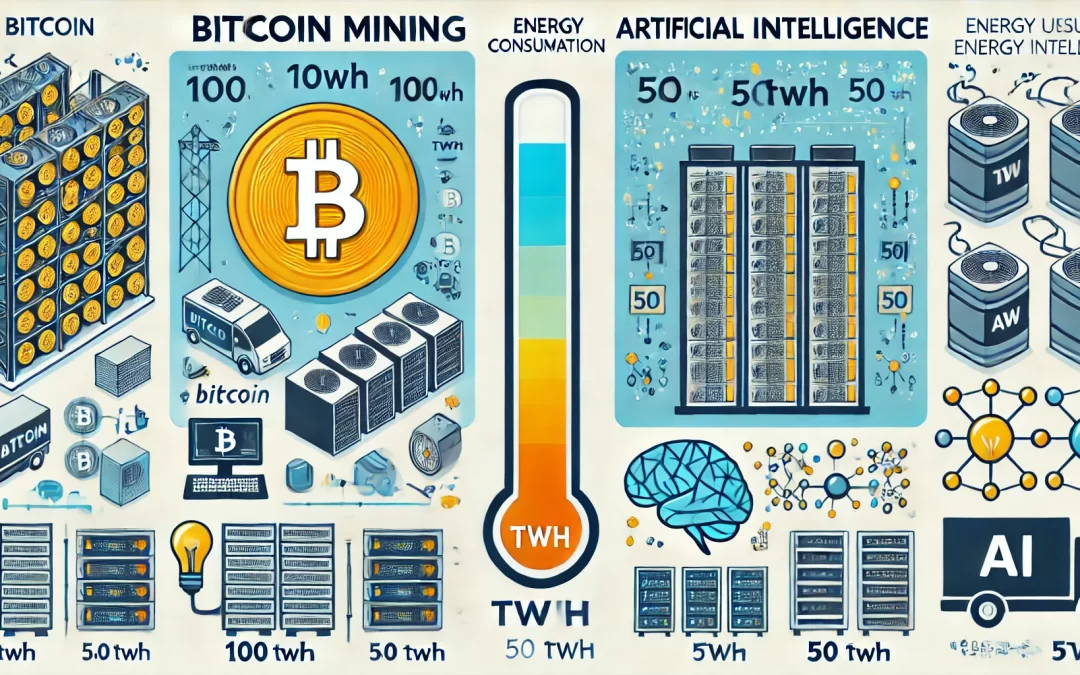
The image above was created by the ChatGPT Image Generator by searching the phrase “Please create a graphic that shows the difference in energy usage between bitcoin and artificial intelligence.” The image features a Bitcoin mining setup on one side and an AI setup on the other, with a balance scale in the center comparing their energy usage. The background includes tech-related graphics and symbols representing both Bitcoin and AI.
Bitcoin and AI are two of the most transformative forces right now in the world of technology, and we at Web Professionals Global are closely following them and what they mean for the future of our profession. Both bitcoin and AI have significant implications for the future of industries and societies worldwide. However, alongside their promise comes a growing concern surrounding the substantial energy consumption required to power these technologies. Today we are taking a look at the energy dynamics of Bitcoin and AI, comparing their consumption patterns, impacts, and the ongoing debate surrounding their sustainability. Readers may remember a similar article we published in October of last year. In less than a year, energy usage and future usage estimates have increased significantly.
Understanding Bitcoin’s Energy Consumption
Bitcoin operates on a decentralized ledger technology known as blockchain. The process of validating transactions and adding them to the blockchain network, known as mining, is integral to its operation. Bitcoin miners compete to solve complex mathematical puzzles, requiring substantial computational power. This mining process, essential for maintaining the integrity and security of the network, consumes a staggering amount of energy.
The primary driver of Bitcoin’s energy consumption is the Proof of Work (PoW) consensus mechanism. PoW involves miners using specialized hardware to solve cryptographic puzzles, a process that demands immense computational resources. As more miners participate and the network grows, so does the difficulty of these puzzles, leading to increased energy consumption. In fact, the Cambridge Bitcoin Electricity Consumption Index estimates that Bitcoin consumes 112.31 TWh (terawatt-hour) annually. This equals the entire energy consumption of some countries around the world.
Critics argue that Bitcoin’s energy footprint is unsustainable, citing its environmental impact due to reliance on fossil fuels and the potential strain on global energy resources. The decentralized nature of Bitcoin means that anyone with adequate hardware and electricity can participate in mining, creating a competitive race that further escalates energy demands.
The Environmental Debate
The environmental implications of Bitcoin’s energy consumption have sparked intense debate. Proponents argue that Bitcoin incentivizes the development of renewable energy sources, as miners seek cheaper and more sustainable power options to maximize profits. However, detractors point to the current predominance of non-renewable energy sources in Bitcoin mining, particularly in regions with low electricity costs driven by coal and other fossil fuels.
Recent years have seen efforts within the Bitcoin community to promote sustainability. Initiatives such as the Bitcoin Mining Council aim to improve transparency and advocate for the use of renewable energy in mining operations. Additionally, advancements in mining hardware efficiency and the exploration of alternative consensus mechanisms, such as Proof of Stake (PoS), could potentially mitigate Bitcoin’s energy intensity in the future.
AI: Energy Consumption and Computational Needs
Artificial Intelligence, encompassing machine learning (ML) and deep learning (DL), represents another frontier in technological innovation. AI algorithms analyze vast amounts of data to derive insights, powering applications ranging from natural language processing to autonomous vehicles. Like Bitcoin, AI’s advancement relies heavily on computational power, albeit through different mechanisms. The semiconductor analysis firm SemiAnalysis estimates that if Google were to use ChatGPT for every Google search it would require 29.2 terawatt hours (TWh) of annual consumption.
AI’s energy consumption primarily stems from training deep neural networks. Training involves feeding algorithms with enormous datasets and iteratively adjusting model parameters to optimize performance. This iterative process demands significant computational resources, often requiring specialized hardware such as Graphics Processing Units (GPUs) and increasingly, dedicated AI chips.
While training consumes substantial energy, the deployment phase—where AI models make predictions or decisions in real-time—typically requires less power. This distinction highlights the evolving nature of AI energy consumption throughout its lifecycle, from initial development and training to ongoing operational use.
Comparing Energy Intensities
Quantifying the energy consumption of Bitcoin versus AI involves nuanced considerations. Bitcoin’s consumption is continuous and primarily driven by the mining process, which operates 24/7 across global networks. In contrast, AI’s energy use fluctuates based on demand for training and inference tasks, which can vary widely depending on the application and scale of deployment.
Recent studies have attempted to benchmark these technologies’ energy footprints. While direct comparisons can be challenging due to their disparate operational mechanics, some analyses suggest that AI, particularly during intensive training phases, can rival or exceed Bitcoin’s energy intensity over similar periods. However, AI’s energy demands can vary significantly depending on factors such as model complexity, dataset size, and hardware efficiency.
Towards Sustainability and Efficiency
Both Bitcoin and AI face scrutiny regarding their environmental impact and sustainability. In response, stakeholders across industries are exploring avenues to enhance efficiency and reduce energy footprints.
For Bitcoin, innovations in mining hardware and shifts towards renewable energy sources hold promise. Efforts to promote transparency and accountability within the mining community aim to mitigate environmental concerns while ensuring the network’s robustness and security.
Similarly, AI researchers and practitioners are exploring avenues to optimize algorithms and hardware architectures for energy efficiency. Techniques such as model pruning, quantization, and federated learning aim to reduce computational demands without compromising performance. Moreover, advancements in AI hardware, including the development of more energy-efficient processors, contribute to sustainability goals.
Balancing Innovation and Sustainability
As Bitcoin and AI continue to evolve, so too will the discourse surrounding their energy consumption. The imperative to balance technological innovation with environmental sustainability remains critical. Stakeholders must collaborate to foster responsible practices, leverage renewable energy solutions, and advance energy-efficient technologies.
While challenges persist, the potential benefits of Bitcoin and AI are undeniable. From financial inclusivity and decentralized finance (DeFi) enabled by Bitcoin to transformative advancements in healthcare, transportation, and beyond driven by AI, these technologies offer profound opportunities for global progress. How Bitcoin and AI will ultimately unfold remains to be seen, but the impact of both is already clear.
Research estimates that by 2025, the IT industry could use 20% of all electricity produced and emit up to 5.5% of the world’s carbon emissions. That’s more than most countries’ total emissions outside of the U.S., India and China. All of the computers, routers, smart devices and more that make up the internet use an enormous amount of energy. Additionally, as new technologies such as satellite internet expand coverage to areas that traditionally have struggled to get access, the amount of energy that the internet consumes will only continue to grow.
Wrap-Up
We welcome your comments and questions about this topic and the world of the web. Reach out today to find out more about our mission of “Community, Education and Certification.” We are always happy to have new web professionals join our ranks.